by Brie Barker | Leadership Development
People are not born leaders — but every leader was born. The best leaders have another thing in common, regardless of what sector, industry or professional field they work in, and that’s the ability to communicate effectively with people. Early childhood is the ideal place to begin an education in this essential leadership skill.
My kids are still quite young: Finley is 8 and Clara is 5. They certainly have their own distinct personalities already and I’m so curious to see how they will evolve; who they will become as adults.
And, like most parents, I feel the weight of responsibility, shared with my wife, in not making a complete mess of it all and end up sending them out into the world without everything they need to survive and thrive.
To them, however, their glorious futures are all set:

 Finley’s going to play professional baseball with the Red Sox and Clara’s going to have some yet-undefined career that revolves exclusively around Frozen (“Oh, sorry, sweetie, I think we left that CD at Grandma’s”).
Will these things come to pass? Maybe yes, maybe no. But that’s okay, there’s plenty of time for them to explore more things before they need to focus on getting any concentrated, career-specific education and training.
Like us, if parents of young kids want to maximize the chances of their kids being successful in the working world, no matter what kind of career the kids end up choosing, they will need to be able to communicate effectively with people — and learning those social skills has to happen now.
Because, according to most experts in child psychology and development, the window for learning these social skills starts to close pretty tightly around the age of 8.
Ways to Help Children Develop Their Social Skills:
Thankfully, there are a lot of well-informed experts in child psychology and development out there because that’s not my area of expertise … I know for a fact that even my becoming a parent had nothing to do with what’s on my resumé.
In their article, Social Skills: Laying the Foundation for Success, Sharon Lynch and Cynthia Simpson give a great definition of social skills:

“Social skills are behaviors that promote positive interaction with others and the environment. Some of these skills include showing empathy, participation in group activities, generosity, helpfulness, communicating with others, negotiating, and problem solving.”
Hmmm … sounds like hallmarks of a good leader to me.
The article goes on to provide great strategies that can be used at home, in school and in the community for helping kids develop their social skills, some of which could be applied in the adult workplace, too.
Psychology Today hosts a blog called Growing Friendships, written by Dr. Eileen Kennedy-Moore, which has a ton of helpful and interesting information about children’s social and emotional development.
In a 2011 post of hers, What Are Social Skills? Helping Children Become Comfortable and Competent in Social Situations, she explains three main processes that underly social skills for children — and adults alike:
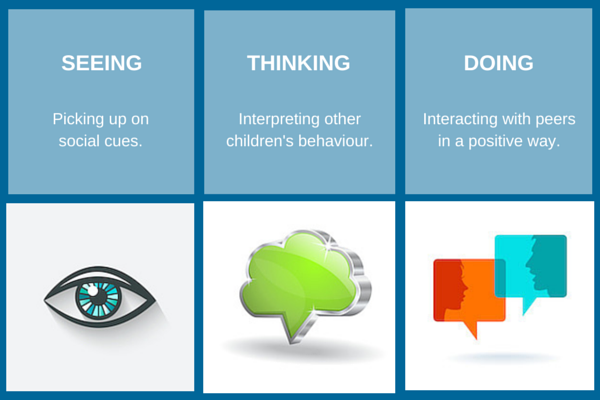
It’s easy to see how these three things translate to the working world of adults. Dr. Kennedy-Moore goes on to say that, “Some kids seem to learn social skills very easily, but others can benefit from some extra coaching.” Same goes for current and aspiring leaders, my friends!
The parents of young children who strike while the iron’s hot and focus on developing their kids’ social skills in those crucial, early years, do their kids a big service.
Will doing so guarantee their kid a leadership role in the working world? No, but their kids will benefit from being able to embody a key part of leadership in whatever role they inhabit.
Am I doing a good job of this with my kids? I hope so. Let’s see what they’re like in another 15 years or so! With any luck, it won’t end up like this.
Part 2 of this series of posts on Leadership Education will focus on undergraduate options for those kids about to leave the nest. My hair will be even more grey when that happens for me … if that’s actually possible.
Leave a comment!
Not sure what to say? Answer one of these questions:
What strategies of yours have worked well in building your kids’ social skills?
What correlation do you see between your own childhood and how you embody your role as a leader?
What’s your favourite song from Frozen? (Besides the one you never have to hear again.)
Have a productive and enjoyable day.
— Brie

by Brie Barker | Leadership Development
As a leader, it serves you to consider where your own persona might be what’s preventing you from hearing the potentially valuable ideas of particular employees. Don’t miss the gems that aren’t expressed with the fanfare of a brass band.
Friends of my wife have a 2,000 acre farm up in New Lisgard, Ontario, about an 8-hour drive from either Toronto or Ottawa, where they raise beef cattle. Last summer, Jen and I decided it was about time we went for a visit, so we packed our rubber boots and told the kids they were going to see where hamburger really comes from.
Being a born-and-bred city boy, I learned a lot of things about life on a farm while I was there. For example, 2,000 acres covers a LOT of land and cows are really quite BIG — and how well Brad keeps track of the whereabouts, health and pregnancy status of all 300+ of them is nothing short of astounding. If Brad’s not there when a cow is giving birth, there’s a very real chance that the calf won’t survive. From a business perspective, the economic benefit that calf represented would be completely lost. The cow could die from the inattention, too.

If the farm you run is indoors, measured in square footage and has a human population versus bovine, then it’s the good ideas your herd is capable of producing that you can’t afford to miss. Beyond having to create an environment where new ideas can gestate (a great topic on its own), you have to be sure you can hear the moo of every employee who is trying to contribute.
As a leader, it serves you to consider where your own persona might be what’s preventing you from hearing the potentially valuable ideas of particular employees.
For example, last week I was working with a client — we’ll call him Jeff — who felt unheard by his boss. Jeff is keenly aware that he’s very shy and soft-spoken; he also holds the belief that decisions should be guided by facts. By great contrast, Jeff describes his boss as one who is always outgoing, loud, extremely confident and makes decisions based on his gut-feelings, without input from others.
When Jeff tries to give what he believes to be valuable input to his boss, his boss’s now-predictable response quickly leaves Jeff feeling overwhelmed, unheard and unvalued: he ends up retreating and shutting down.
Although I was working with Jeff to help him learn what he can do on his part to increase the likelihood of being fully heard by his boss, let’s consider the coaching tips for Jeff’s boss that could increase his capacity to hear Jeff fully.
Shift Your Mindset:
1.  Become a servant leader.
“When we seek to discover the best in others, we somehow bring out
the best in ourselves.” — William Arthur Ward

2. The level of confidence and certainty with which one presents
an idea is not necessarily indicative of the merits of the idea.
Set the Stage:
Express to Jeff your desire to hear and consider his ideas and, acknowledging your tendency to dominate a discussion, give him permission to tell you if he’s starting to feel shut down.
Adapt your Communication Style:
Jeff needs to feel invited and safe to fully express himself:
⇒ Reduce the intensity of your vocal and physical expression to more closely mirror Jeff’s.
⇒ Leave enough silence so Jeff doesn’t feel rushed.
⇒ Encourage Jeff to say more by using verbal nods and showing curiosity with statements like, “Hmmm, tell me more.”
⇒ Ensure Jeff’s said his piece: “Is there anything else in this that you think is important for me to consider?”
⇒ Thank Jeff for sharing his thoughts and that you’ll give them further consideration.
⇒ Follow up with Jeff as to whether or not you implemented his suggestions and why. This doesn’t detract from your authority or send the message that you have to justify your decisions to Jeff, rather, it just demonstrates that you value his ideas. Even if one idea doesn’t prove to have merit, it doesn’t mean the next one won’t — and you want to be sure he feels invited to share it with you.
This is but one example showing what a leader can do to move past their own persona’s restrictions in order to receive the potentially valuable ideas a particular employee has to offer.
How’s your persona getting in the way and with whom?
As a leader, what can you change in your own behaviours to remove your barriers?
Lacking opposable thumbs, how likely is it that even a really smart cow could send a text message?
Have a productive and enjoyable day.
— Brie

by Brie Barker | Leadership Development
Trust is the lifeblood of effective, enduring leadership.
Want your employees to trust you enough to follow you just about anywhere?
Here are 4 things you can do to earn trust as a leader.
Read the following list while embracing two important concepts:
» Trust is based on the emotional connections between people, not on the connections between people on an org chart.
» Heed the good advice of Aristotle that any good novelist, playwright or screenwriter does: character is action.
1. Show Your Face:
You know the show Undercover Boss? Strive to never be a viable candidate for that show. You want to be the boss that every one of your employees will take one look at in that disguise of yours and say, “Hey, nice try! I know who you are!”
But it needs to go beyond that.

©DonkeyHotey
Don’t be that holy visitor from the top floor who walks briskly through the cube farm and bellows Pythonesque pomposities like, “Morning, Johnson! Keep up the good work now!”
You need to know who they are. You need to demonstrate you care about them by taking an interest in who they are and what their day-to-day working reality is all about: what the value they bring to the organization is, what their challenges and suggestions are.
If you’re leading such a big group of people that the goal of knowing all of them is just not feasible, you should still schedule a regular time in your calendar to make the rounds and have some meaningful face time with as many as you can. This is not an all or nothing scenario.
Trust is based on relationship. The person who is trusted never has to say, “Trust me,” and will never hear the reply, “Trust you? I don’t even know you.”
2. Put Your Employees’ Interests Above Your Own:
If you poll your employees about whether or not they trust you, many of them will filter this question as, “Do I trust them to do what’s best for me?” Or, in other words, do they think you’ve got their back; that, when the chips are down and things get tough, do they trust that you’ll put their interests before your own personal interests.

For a deeper exploration of this, delve into Simon Sinek‘s latest book, Leaders Eat Last.
For a more concise affirmation, trust Spock’s statement, “The needs of the many outweigh the needs of the few – or the one.”
3. Lead by Example:
Think about any movie you’ve ever seen that involves an armed battle. Now think about the leaders of each opposing side. Which side almost always emerges victorious? The side whose soldiers have the most trust in their leader — the side who’s leader joins them in the actual battle, not the one who commands from the safety of the rear.

If you’re calling on your employees to sacrifice for the good of the organization, you need to sacrifice, too. You need to be right there in the trenches with them, sleeves rolled up, showing them you believe in the cause you’re asking them to fight for.
4. Trust the People You’re Leading
Another key factor in earning the trust of your employees is demonstrating that you trust them.
I’m not talking about throwing people into the deep end, just assuming they can swim to the other side, and then saying, “Hey, I gave you a chance to prove yourself and you blew it. From now on you don’t leave the shallow end unless I’m there to watch you.” The only people who should be micro-managed are those who respond well to being micro-managed.
Rather, give your employee a goal to accomplish, ask them to devise and show you their plan to achieve it, offer any necessary guidance, and then get out of the way and empower them with 100% trust to accomplish it. Based on the results, adjust the amount of active support you need to give them. You’ll soon discover what their full abilities are: if they meet or surpass the expected standard, great, you know you can trust them to get the job done; if they don’t meet the expected standard, you can collaborate on a learning and development plan to address the areas of needed improvement. Do this and they’ll trust you have their best interests at heart.
 “The best way to find out if you can
trust somebody — is to trust them.”
— Ernest Hemingway
Have a productive and enjoyable day.

by Brie Barker | Leadership Development
If you lead a team of people, be they senior executives, managers or support staff, you might be unknowingly asking stacked questions. The end result is that you’re not likely to get the information that led you to ask the questions in the first place … and you might not even realize it.
There have been a lot of courtroom drama series on TV over the past few years that I’ve enjoyed, such as The Good Wife, Boston Legal and Suits. One scenario I’m sure everyone’s seen is the lawyer who’s pummelling a witness on the courtroom stand with a relentless, continual barrage of questions. It’s a technique that usually ends up with the witness getting rattled and confused and either being discredited or, in fine TV tradition, cracking under the pressure and confessing to the crime.
Well, listen closely to people at work when they’re asking questions and, chances are, you’ll hear many of them asking stacked questions, i.e. ones that come one right after another with no space in between that gives the other person a chance to answer.
Unlike the TV lawyer, it’s highly likely that your co-worker has no idea they’re doing this. The questions may not have any hard edge to them either, rather, the person is just trying to get some helpful information from the other party.
Here’s the problem … when you ask stacked questions, the person on the receiving end is likely to either:
1. Only answer the last question that is asked,
2. Only answer the question they feel most comfortable answering,
3. Provide an answer that tries to address all the questions but doesn’t really answer any of them.
Why does this happen? Let’s consider the person on the receiving end of the questions first:

It’s going to be rare that the person on the receiving end is 100% present, in a perfect Zen-like state of mind where they are listening to you without distraction, ego or filters. Like most of us, they’re probably going to have a lot of other things going on in their mind, be consciously or non-consciously thinking about their own interests (hello, Ego), and be hearing the questions through a set of filters built on the historical, emotional landscape of the relationship.
Expecting the person to fully track, process and respond to all of the stacked questions is unrealistic. So, the person just tries their best.
Now let’s consider the person who’s hearing the response to their stacked questions: their ability to be 100% present to the other person is likely just as compromised as their’s is.
So, here’s what the average person’s brain will do in this situation: if the brain registers an answer that corresponds to one of the questions that was asked, it closes the loop, i.e. a question was asked and a relevant answer was received. Done! Perhaps the person will probe deeper to get more information on that particular question, but their brain is not likely to take them back to address the other questions. In other words, because the brain is just trying to keep up with all of its thoughts — or “mind noise” — the brain just lumps all of the questions they asked as “the question” and that the questioned answered meant “all questions answered.”
At best, the person will later realize that they didn’t get all the information they were looking for and then go back to the other person to try again. It’s like going to put on a clean shirt and only then realizing that one of the stains you meant to get out was still there. It’s not the laundry machine’s fault that you forgot to take your time to ensure you individually pre-treated all of the stains you wanted taken care of, right? (Sigh) Rinse; repeat.
At worst, the person will never realize they didn’t get an answer to the other questions and forget about them, perhaps until it’s too late and it causes a problem — having the CEO point out in the senior staff meeting that you’ve got a mustard stain the size of Wisconsin on your shirt will do nothing to help your career.
So … what should you do?
Become as deliberate and practiced in asking one question at a time and giving space for as full a response as the hotshot TV lawyer is in using stacked questions as a cross-examination technique … unless, of course, you’re trying to get someone to confess to stealing your sushi from the lunchroom fridge.
Have a productive and enjoyable day.

by Brie Barker | Leadership Development
We all know the adage, “There is no ‘I’ in ‘Team’.” Actually, there are times when the ‘I’ needs to be embraced in order to get the most out of the team.
I was working with a client this past fall — we’ll call her Josée — who felt at a loss on how to better engage one of her staff members — we’ll call her Anita.
Josée manages a team of about 15 people. Josée’s a very energetic and social person and she places a great value on teamwork. She believes team productivity comes from working collaboratively and spending quality social time together. Josée said that every one of her staff members embraced her approach; every one, that is, except Anita.
Josée said that Anita had never really fit in with the rest of the group. She actively resisted working collaboratively, preferring to work on her own, and her going out with the gang for lunch or after work happened only once in a blue moon. And, lately, these things had intensified to a point where Josée felt it was having an increasingly negative effect on the whole team, dragging down morale, with gossip eating away at productivity.
Josée said she tried everything she could think of to get Anita more engaged but nothing had been working.
What Josée hadn’t considered, was that there is, indeed, a place for “I” in “Team”.
Without intent or malice, Josée was actually making the whole situation worse.
Anita was only a problem because Josée was judging her through her own filter and not honouring the way that Anita is naturally wired:
⇒ Josée prefers working with people, Anita prefers working alone.
⇒ Josée is an open book regarding her personal life, Anita prefers privacy.
⇒ Josée likes to socialize after hours, Anita just wants to get home to her family.
The more Josée pressed Anita to open up, socialize and work in active collaboration with her colleagues, the more Anita withdrew, the more the gossip kicked in and, as was happening, the more it was effecting Anita’s ability to do her job well. If Josée didn’t change her ways, it probably wouldn’t been long before Anita just quit.
To be an effective manager, one has to recognize and accept the way people are wired and find a way to honour their strengths and put them in a role that plays to those strengths as much as possible.
Josée needs to:
⇒ respect Anita’s desire for privacy,
⇒ find as many ways as possible for Anita to work independently, and
⇒ publicly value Anita’s output as a positive contribution to the team.

When it’s leveraged in positive and productive ways,
there certainly is a valuable place for “I” in “Team.”
Have a productive and enjoyable day.